Handicrafts of Great Khorasan

Handicrafts of Great Khorasan

Journal of Greater Khorasan Handicrafts

The Journal of Greater Khorasan Handicrafts is a scholarly journal published by Imam Reza International University, with the support of the University’s Research Center for Architecture and Urban Planning.The journal aims to publish research related to the study, analysis, and documentation of handicrafts across the historical and cultural expanse of Greater Khorasan and their artistic and cultural connections with neighboring regions, including Afghanistan, Turkmenistan, Tajikistan, Uzbekistan, and Kyrgyzstan. It examines the historical, cultural, technical, and aesthetic aspects of handicrafts and their developments.

The Journal of Greater Khorasan Handicrafts is published quarterly in electronic format. The language of publication is Persian, and extended English abstracts are provided for the articles. The peer-review process is conducted electronically and double-blind, and each article is reviewed by at least two reviewers. The full text of published articles is freely and openly accessible through the journal’s website.

To verify the originality of texts, the journal recommends that authors obtain a text-originality certificate from the Samim Noor similarity-detection system before uploading their articles. According to the journal’s stated policy, the similarity rate of an article’s text must be less than 10 percent.

The Journal of Greater Khorasan Handicrafts adheres to the principles and guidelines of the Committee on Publication Ethics (COPE) and follows the executive regulations of the Law on the Prevention of and Combating Fraud in Scientific Works. The journal holds a publication license from the Ministry of Culture and Islamic Guidance and is indexed in Magiran, Noormags, the Scientific Information Center of Academic Jihad (SID), Google Scholar, and the Islamic World Science Citation Center (ISC). It also received a Grade “B” ranking in the 1405 evaluation by the Commission for Academic Journals of the Ministry of Science, Research and Technology.

Journal Abbreviation: HGJ

License Holder and Publisher: Imam Reza International University

With the Support of: Greater Khorasan Research Institute – Imam Reza (AS) International University

Director-in-Charge: Alireza Sheikhi

Editor-in-Chief: Ahmad Salehi Kakhki

Postal Address: Mashhad, Palestine Square, Shahid Montazeri Boulevard, Imam Reza International University, Postal Code: 553-91735

Email: Kaj@imamreza.ac.ir

Website: https://hgj.imamreza.ac.ir/

Review Type: Electronic, double-blind, with the participation of at least two reviewers

Publication Type: Electronic quarterly

Open Access: Yes

Language of Articles: Persian, with extended English abstract

Maximum Allowed Similarity Rate: Less than 10 percent

Article Submission, Review, and Acceptance Fees: None

Initial Review Time: 10 days

Average Peer-Review Process Time: 4 to 8weeks

Year of First Publication: 2023

Copyright License: CC BY 4.0

Electronic ISSN (e-ISSN): 3092-7498

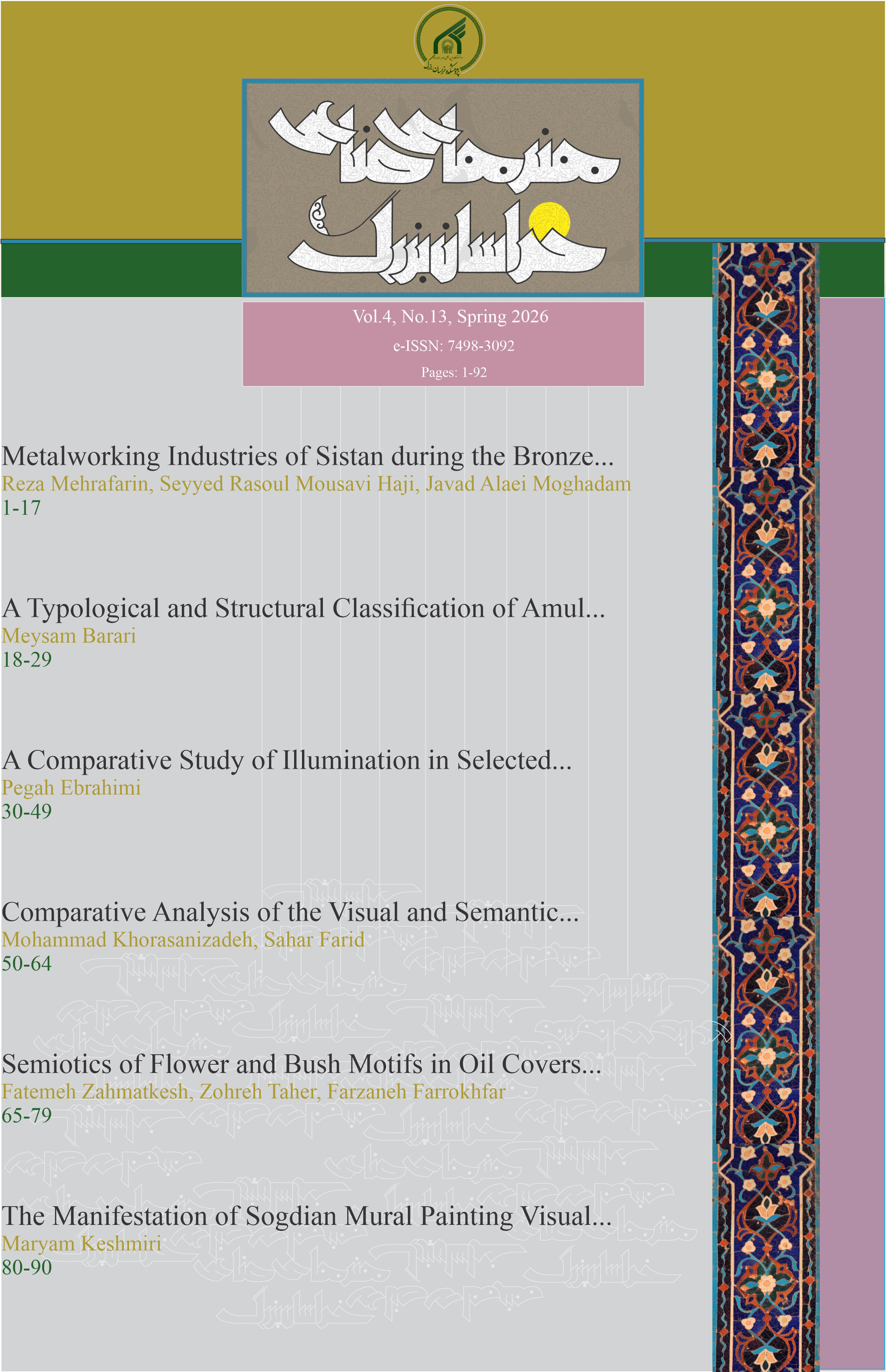
Current Issue: Volume 4, Issue 13, Spring 2026 

Keywords Cloud

  • Carpet
  • Persian Painting
  • Safavid period
  • Qajar Period
  • Handicrafts
  • Mashhad
  • Motifs
  • practical mysticism
  • Great Khorasan
  • Khorasan
  • Safavid
  • Geometry
  • Color
  • visual and semantic analysis
  • pulpit
  • cognitive analysis
  • Imam Reza
  • figurative art
  • Islamic symbolism
  • Visual structure
  • Shahnameh of shah tahmasb
  • Ilkhanate architecture
  • wood carving
  • flower of Shah Abbasi
  • Brick ornaments
  • Traditional Drafting
  • stucco mihrab
  • Tholobate
  • Imaginary power
  • Quran of Mir Abdul Qader Hosseini Shirazi
  • Ghurids
  • Hiall
  • Brick Arches
  • Neyshabur Murals
  • Greater Khorasan
  • Gaze
  • 6th Century to the Mid-8th Century AH
  • Timurid
  • Shahr-i Sokhta
  • Inscription
  • Architectural decorations
  • Tāybād
  • Rug
  • art anthropology
  • Amul Ware
  • Qashqai carpet
  • Hazrat Reza shrine
  • Seljuks
  • Shi‘i discourse
  • tombstone engravings
  • Ribat Mahi
  • enunciative positions
  • style
  • School
  • Fibonacci numbers
  • Qajar
  • Architectural Ornamentation
  • Tabriz Bazaar
  • Bronze Age
  • Brick decoration
  • Haft Shahr Eshgh carpet
  • endowment tradition
  • grave fund
  • School of Shiraz
  • The architecture of east of Iran
  • Carpet weaving
  • Elimaie
  • Tree of life
  • Safavid-era figures
  • Yaqzah
  • Transformation
  • Khorasan wood carving. 9th century wood carving
  • َ Archaeology Surveys
  • Musical treatise
  • Astan Quds Razavi Artists
  • Iranian Paintings
  • descender letters
  • flower and bush motifs
  • Metalworking
  • Iranian painting
  • Wood
  • Islamic Beliefs
  • Semiotic perspective
  • Sangesar
  • Islamic art
  • Shahnameh of Shah Ismail
  • Khorasan and Sistan
  • Timurid period
  • Dodar School
  • Quran Manuscript No. 3248 of Astan Quds Razavi
  • halo
  • Freer\'s Haft Awrang
  • Peirce\'s semiotics
  • Chester Beatty Dublin manuscript Quran
  • Shamseh Hasht
  • contemporary tilework
  • key symbols
  • Envelope Cover
  • Kamaluddin Behzad
  • palette
  • Islamic Ceramics
  • Ancient City of Toun
  • Spiritual Leadership
  • Second Pahlavi
  • Mashhad School
  • Illuminating
  • Safavid Era
  • Window
  • Islamic architecture
  • Seljuk metalwork
  • Zahhak Bound on Mount Damavand
  • Art Education
  • Contemporary
  • Persian garden
  • design and pattern
  • Timurid Manuscripts
  • Mahmoud Farshchian
  • Torbat-Jam
  • Derrida
  • Imam Reza shrine
  • Samarkand
  • Second half of the Eighth Century AD
  • Prophet Solomon (AS)
  • illuminating decorations
  • Iconography
  • Art criticism
  • Nishapur Pottery
  • Sultan Muhammad (the painter)
  • Islamic buildings
  • symbolic motif
  • Astan Quds Razavi Printing House
  • audience-centered
  • pictorial abstraction
  • horizontal elongations
  • Quran of Rooz Bahan Shirazi
  • Quran manuscripts
  • jouissance
  • Safavid era carpet
  • Frame Paradigm
  • The Conference of the Birds (Mantiq al-Tayr)
  • Samanid Art
  • Stylistics of illumination
  • Patterns
  • Balqis
  • Gazelle Motif
  • form and motif
  • Design Method
  • Astan Qods Razavi
  • Samanian Art
  • rounded letters
  • Abd al-Rahman Sulami Nishaburi
  • Great Silk Road
  • Miniature
  • Herat
  • wooden designs
  • Handmade carpet
  • Shia Ideologies
  • Islamic Period
  • Masjid-I Kirmani of Turbat- I Jam
  • Gypsum decoration
  • 3D printer
  • Architecture
  • Fourfold Versified Stories
  • Mir-Haydar&‌rsquo
  • Aliabad Keshmar Tower
  • Tape weaving
  • Illumination
  • Literature
  • proportionality of numbers
  • handwoven
  • Timur (Tamerlane)
  • Turkmen
  • Bird Symbolism
  • tomb of Arsalan Jazeb
  • Structural patterns of Persian costume
  • lion symbol. Dragon symbol
  • structural analysis
  • Titus Burckhardt
  • Kamal Al-din Behzad
  • tilework in architecture
  • Contrast
  • lithography
  • Archaeological Monument
  • Abdullah Ansari (Sage of Herat)
  • Qazvin school
  • Sistan
  • Timurids
  • myth
  • Astan Quds Razavi Museum
  • Traditionalism
  • Conservation and reconstruction
  • Zoomorphic representation
  • Tabriz
  • Bukhara
  • Holy Shrine of Imam Reza (PBUH)
  • Semiotic Square
  • Structural Classification
  • Parthian Period
  • Qajar era carpet
  • Zoomorphic containers